Rocket Mortgage / Rocket Pro / June 2026
Streamlining Mortgage Closing Dates
Brokers couldn't update signing dates until late in the loan process, and had no visibility into why specific dates were unavailable. This generated ~3,500 monthly support tickets. As the solo designer, I redesigned the calendar experience to provide date transparency and earlier date selection.
Details
Rocket Pro calendar redesign shipped in August 2024, currently being implemented by engineering teams with expected launch in June 2026.
Challenge
Brokers generated ~3,500 monthly support tickets because they couldn't see why closing dates were unavailable and couldn't update them until late in the loan process.
Solution
Redesigned the calendar with dual date selectors, tooltips explaining unavailable dates, and visual warnings for expiring documents—reducing friction and support burden.

Brokers generated ~3,500 monthly support tickets requesting date changes because the system lacked transparency into why dates were unavailable.
When Rocket Pro launched the closing calendar, brokers could only update signing and disbursement dates at specific stages in the mortgage process. If they needed a different date, they had to contact support—generating approximately 3,500 support tickets monthly.
Out of 2,500+ monthly visits to the closing calendar page, only 60% resulted in a successful date submission. The remaining 40% abandoned the task, likely confused about why dates were blocked or when they could make changes.
The calendar was also limiting broker control: they couldn't select dates early in the process, even if they wanted to plan ahead or accommodate borrower preferences.

I collaborated with customer support and operations teams to identify all constraints that restrict date availability, discovering 19 different reasons why a date could be blocked.
Most restrictions related to document expiration dates (mortgage note, deed of trust, etc.), but also included rate lock expiration, regulatory waiting periods for short sales, and other compliance requirements.
I interviewed support staff handling the 3,500 monthly tickets and analyzed patterns in their requests. I also mapped user flows showing how signing and disbursement dates are interdependent: disbursement date availability depends on the signing date selection.
Understanding these 19 constraints meant designing a system that could explain complex mortgage operations logic to brokers without requiring them to understand every operational detail. The constraint documentation became the foundation for both the design and the engineering implementation.

Phase 1 focused on providing transparency: tooltips explaining why dates were unavailable, and a dual calendar design that clarified the signing/disbursement dependency.
My instinct was to keep it to a single calendar. Two calendars felt like more work for the broker, and I spent significant time — probably 20 variations — trying to make one calendar work. The core interaction I kept returning to was a single calendar with separate input fields for signing and disbursement dates, letting brokers select both from one view.
It broke down quickly. The disbursement date is conditional on the signing date selection, which means available disbursement dates change dynamically based on what the broker picks first. In a single calendar view that's already showing one month, handling the case where a signing date near the end of the month pushes disbursement options into the following month created a layout problem with no clean solution — the calendar either felt cramped or jumped unpredictably.
Two separate sequential calendars — one for signing, one for disbursement — was the answer I kept resisting because it felt like more UI. But it was actually simpler for brokers. Each step has one job. The dependency between the two dates becomes part of the flow rather than something the interface has to visually reconcile. Sometimes the right solution is adding a step, not eliminating one.Instead, I designed two sequential calendars: first select the signing date, then select the disbursement date. This sequential flow mirrors the actual dependency and makes the conditional logic clear without explanation.
When brokers hover over an unavailable date, a tooltip appears with the specific reason: "Rate lock expires 3/15" or "Mortgage note expires 3/22" or "30-day waiting period required for short sale closings."
I wrote many versions of these tooltips to balance detail with brevity—brokers needed enough context to understand the restriction and potentially ask their account executive for an exception, but not so much detail that they became overwhelming.

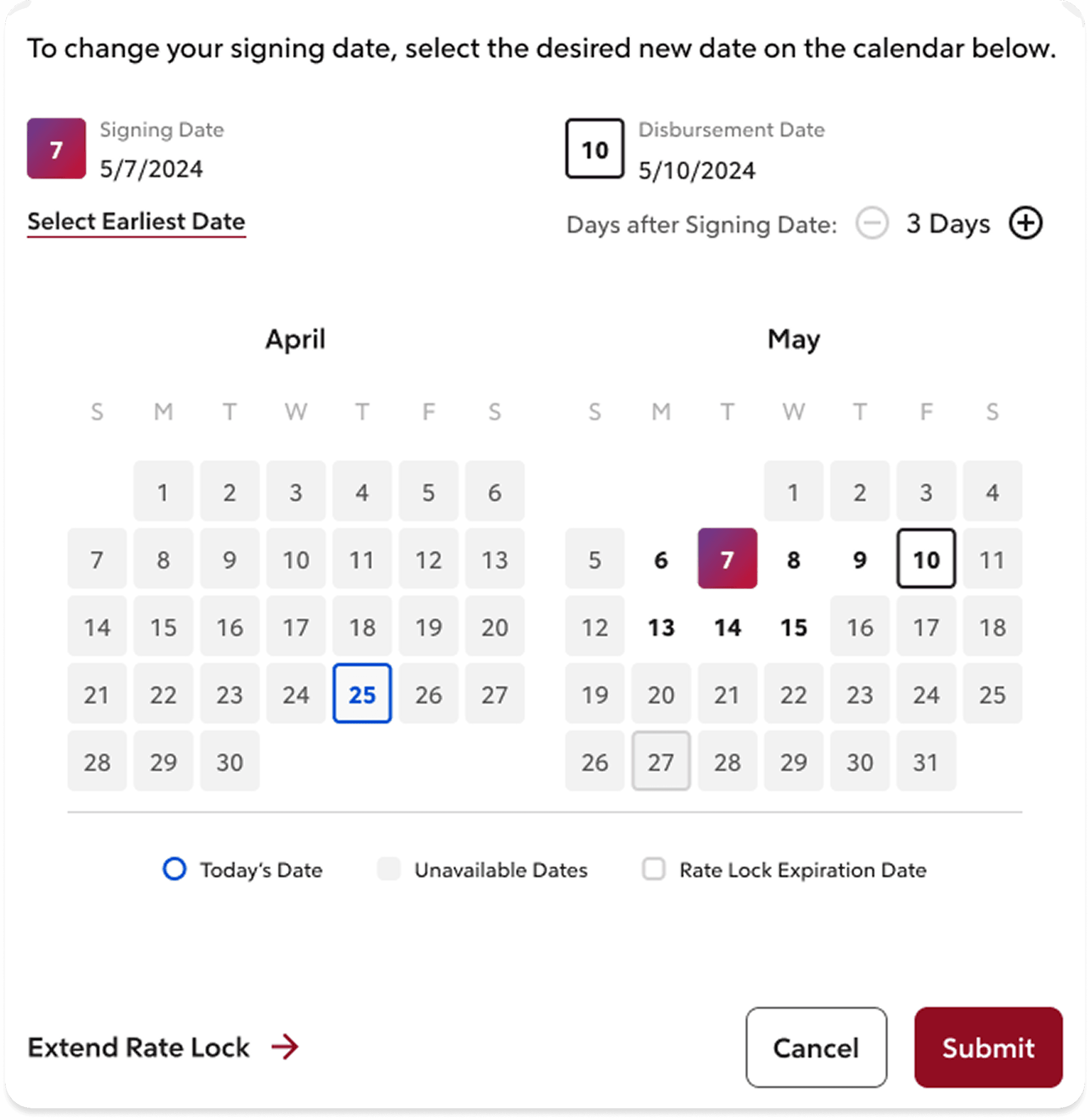


Phase 2 expanded flexibility by enabling earlier date selection while adding visual warnings for dates that would expire documents.
Initial user feedback showed that some brokers wanted flexibility to select dates earlier in the process, even if documents would expire. This required significant design expansion.
We introduced a visual warning system: dates that would cause document expirations appear in orange (our semantic warning color). When a broker selects an orange date, they see a list of which documents will expire with a confirmation prompt: "Are you sure? These documents expire before your new date."
We also added critical messaging: "Documents must be re-uploaded to the portal at least 3 days prior to the new signing date." This ensures brokers understand the consequences of their choices so they can advise their borrowers and manage the re-upload process accordingly.
This two-phase approach balanced business constraints with user needs—giving brokers more control while keeping them informed about the operational impact of their decisions.
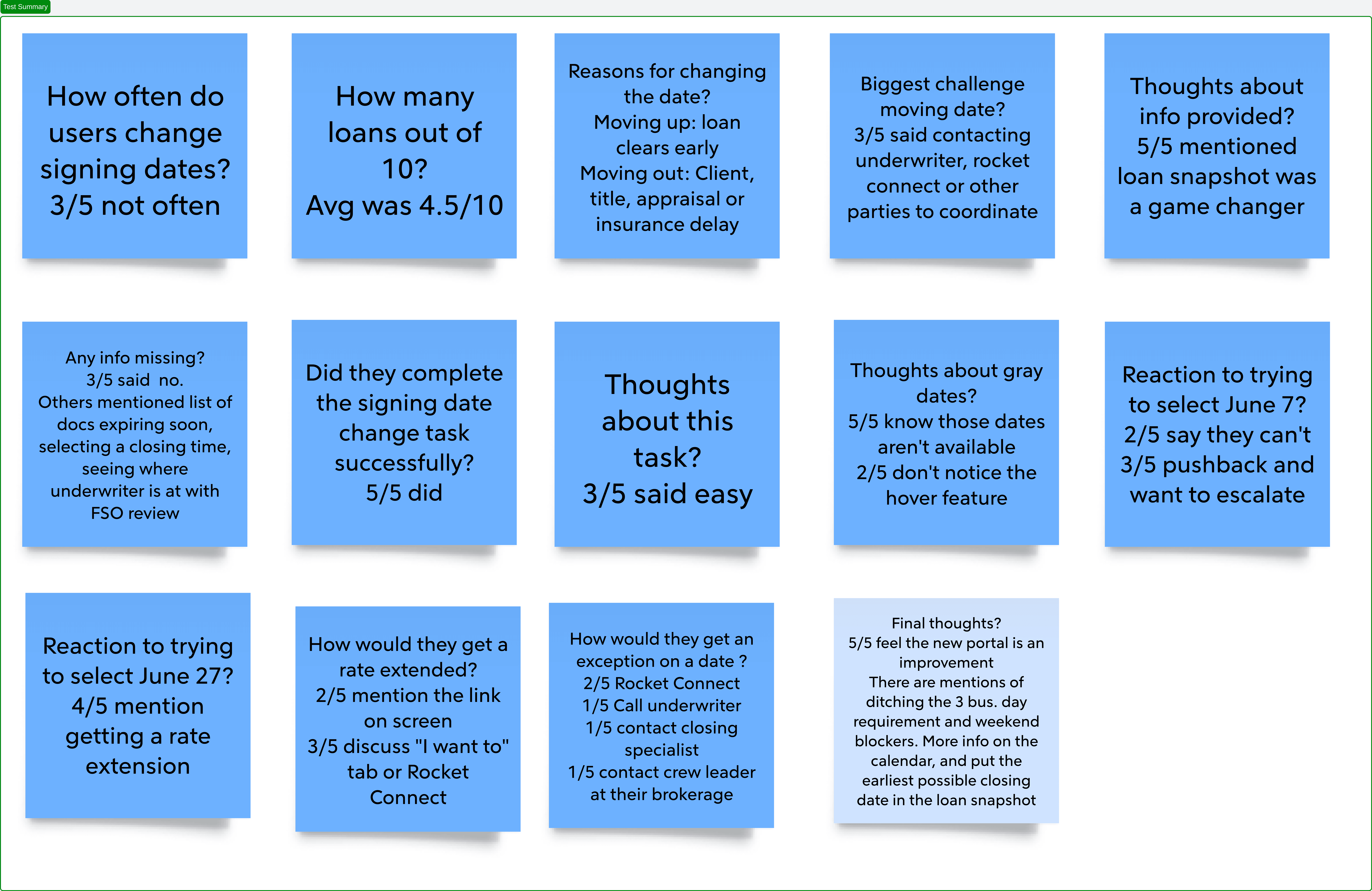

During moderated user testing, all participants successfully selected dates and identified why dates were unavailable, validating our tooltip and dual calendar design.
Participants were universally positive about the redesign. Key feedback:
"The loan snapshot was a game changer" (mentioned by 5/5 participants)
"I feel the new portal is an improvement" (common final thought)
"3/5 said easy" when describing the task difficulty
Interestingly, when asked what they'd do if a borrower requested an unavailable date, participants split into two camps: some said they'd call their account executive to request an exception; others would guide their client to select a different date.
This insight informed how we positioned the tooltips—they needed to provide enough context for both responses. Brokers who want to request exceptions need enough detail to justify their request. Brokers who guide clients need clear enough explanations to help their borrowers understand the constraints.


The redesign is projected to reduce ~3,500 monthly support tickets by providing date transparency and earlier selection flexibility, addressing years of broker frustration with limited control.
By allowing brokers to see exactly why dates are unavailable and select new dates earlier in the process, we eliminated the need for support team intervention in most cases.
Projected impact once launched:
3,500 fewer monthly support tickets
40% improvement in task completion rate (from 60% to 100%)
Support team freed up to focus on complex issues instead of manual date adjustments
Beyond the metrics, brokers now have visibility and control over their closing timeline. The two-phase approach—first transparency, then flexibility—gave us space to test assumptions and expand based on real user needs rather than trying to solve everything at launch.
Engineering is currently implementing Phase 2, with expected launch in June 2026. This project demonstrates the value of thoughtful constraint documentation and iterative design when managing complex business logic across large teams.