Rocket Mortgage / Rocket Pro / November 2025
Adding DSCR Loans To Rocket Pro
As the sole designer, I integrated DSCR loans across six workflows, coordinating with 200+ people to deliver a product now generating $160M in loan volume - a product partners had requested for years.
Details
Integrating a new loan product across 6 workflows and 50 pages over 6 months, coordinating with 200+ cross-functional partners.
Challenge
DSCR launched as a standalone product within Rocket Pro, generating $160M in loan volume by enabling brokers to serve real estate investors—a market segment previously inaccessible.
Solution
Designed the product for flexibility with conditional logic and comprehensive documentation so that rapid changes in investor requirements could be accommodated without full redesigns.
Impact after 6 months
Loans closed
Loan volume
What started as a "handful of screens" expanded into updates across six workflows, with requirements changing weekly throughout the 6-month project.
DSCR qualification works differently than conventional loans - borrowers qualify on rental income, not employment. This meant rethinking workflows across the entire portal: pricing calculator, loan application, self-service edits, change in circumstance, rate lock, and appraisal.
We launched two products simultaneously (30-year fixed and 40-year interest-only), each with different requirements. I received Slack messages with new field requirements regularly - sometimes conflicting with previous specs. With over 110 stories in Azure DevOps, maintaining clear documentation became critical to keeping multiple engineering teams aligned.
Since DSCR is sold to private investors whose requirements can shift based on market conditions, I designed for flexibility with minimal hard-coded logic.
Unlike conventional loans with stable government guidelines, DSCR investor requirements could change at any time. I designed conditional fields that could be turned on or off, validation rules that could be adjusted without UI changes, and clear separation between system requirements versus investor preferences.
This approach meant more upfront design work - annotating every state, documenting every variation - but it paid off when investor requirements shifted mid-project and we could accommodate them without redesigning entire workflows.

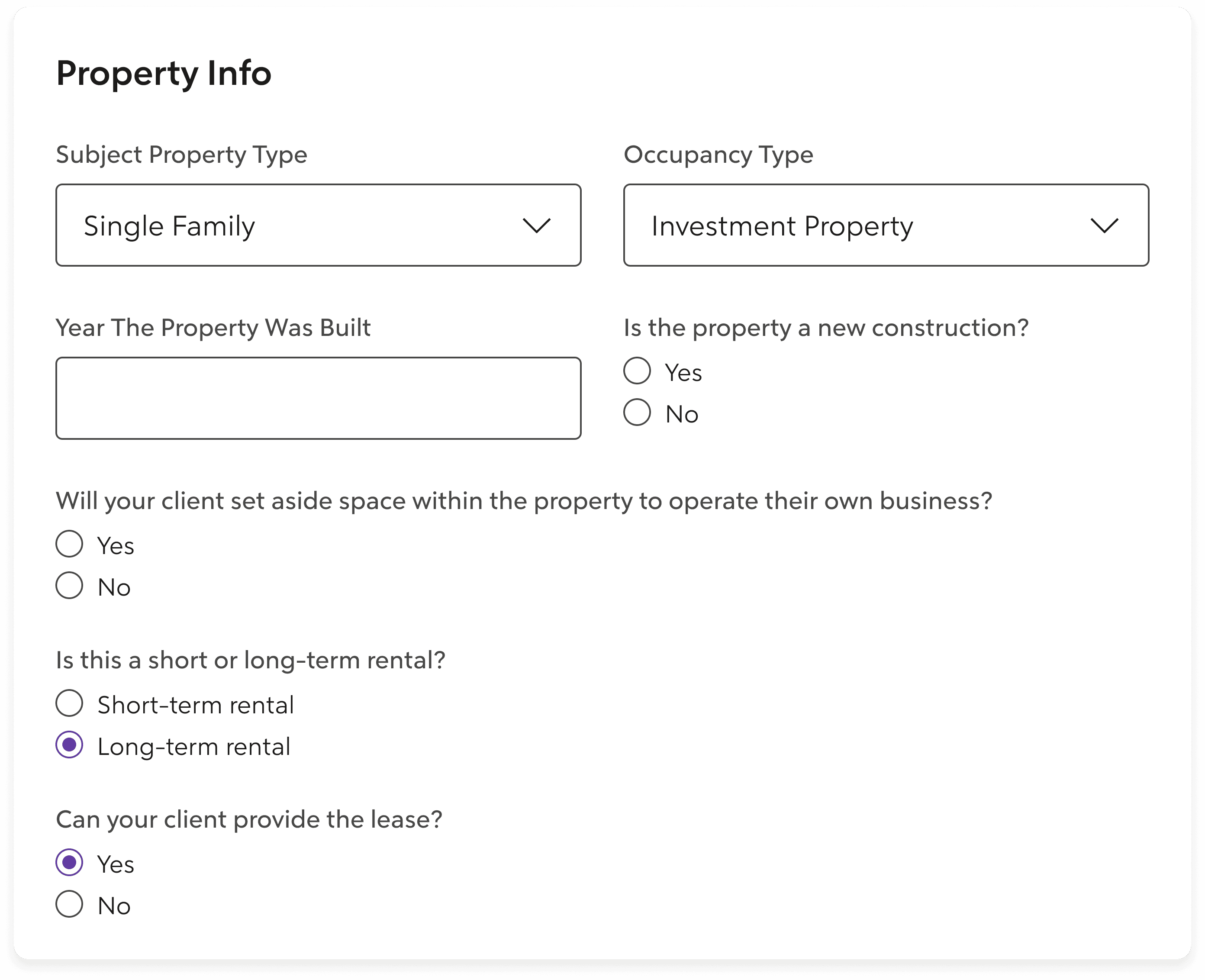
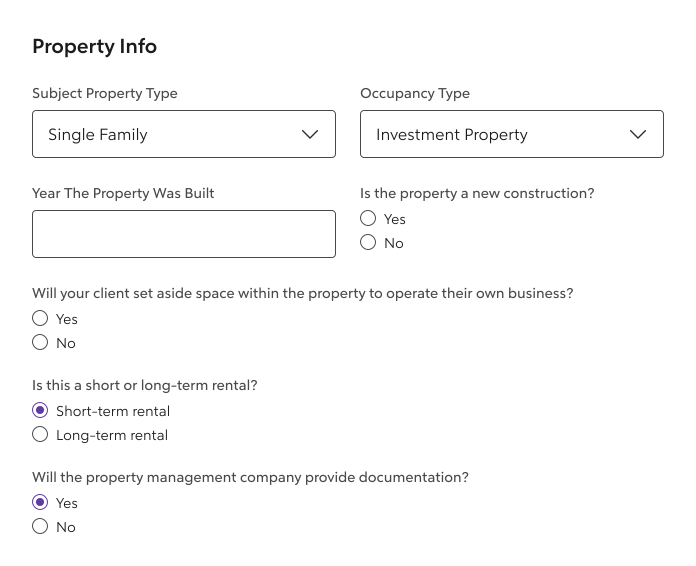
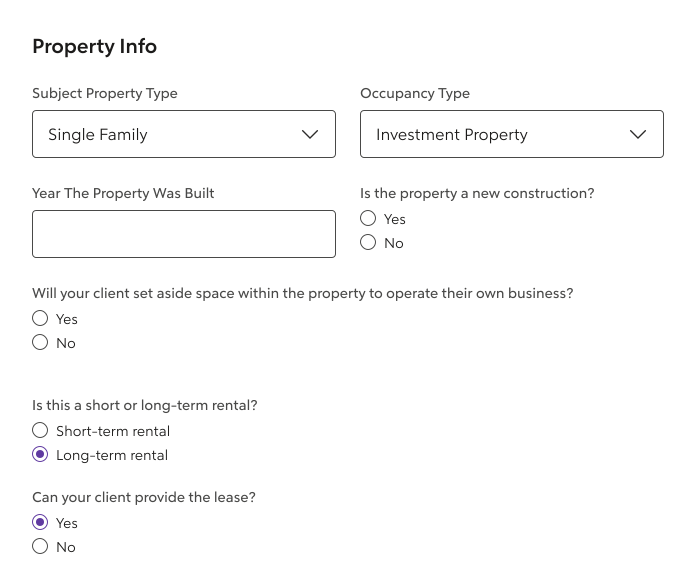
Features like prepayment penalties varied by state, requiring organization of complex conditional logic that remained invisible to the user.
Prepayment penalty rules varied by state, loan type, property type, and investor guidelines. I used radio button groups that showed or hid options based on the subject property's state. When a partner selected California, certain prepayment options disappeared entirely. When they selected Texas, different options appeared.
The challenge wasn't just organizing the logic - it was making it invisible. Partners shouldn't need to understand state-by-state regulations. The interface should just show them what's allowed for their specific scenario.

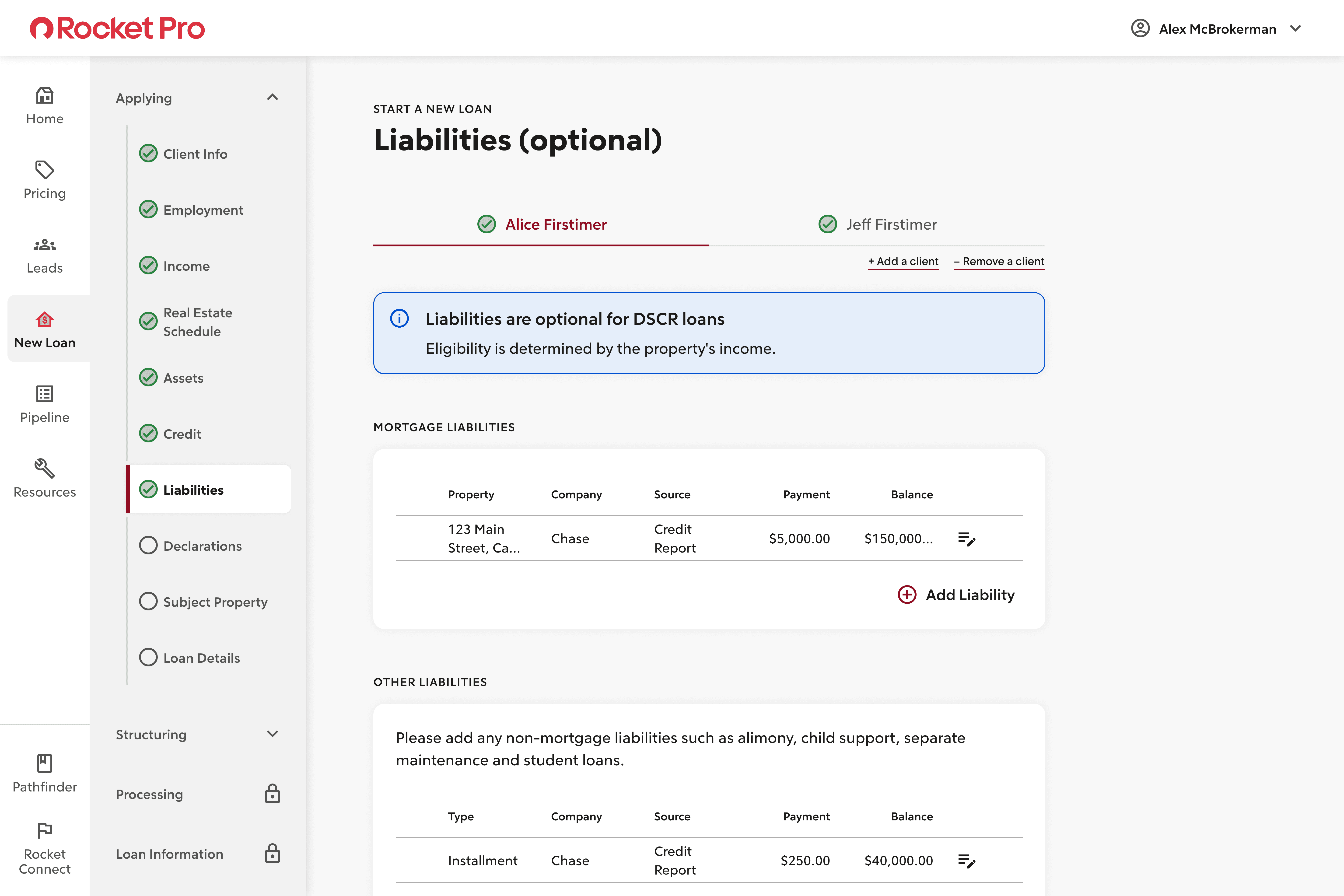
DSCR loans don't require employment or income data, so I introduced alert banners to communicate optional pages without breaking the familiar application structure.
The obvious UX solution was to remove pages that didn't apply — if DSCR borrowers don't have traditional employment or income, why show those screens at all? But this created a business problem: DSCR investor requirements could shift based on market conditions. Building conditional routing logic that removed pages entirely would mean engineering updates every time requirements changed.
I recommended keeping the familiar page structure intact but making optionality explicit. Alert banners at the top of each optional page explain why it doesn't apply to DSCR loans. We also marked these pages as complete in the progress tracker before partners reached them, so the application felt like it was moving forward even when pages were skipped. This preserved the familiar application structure brokers already knew, while keeping the underlying logic flexible enough to accommodate investor requirement changes without UI redesigns.



Before designing DSCR pricing updates, I had to rebuild the calculator's Figma file from scratch — creating a source of truth that didn't exist.
The pricing calculator design file hadn't been updated in years and no longer reflected the current implementation. Before I could design DSCR-specific updates, I had to rebuild the Figma file from scratch to accurately document the existing experience — essentially creating a source of truth that didn't exist.
From a user perspective, the changes were targeted: a new field for DSCR-specific inputs and a new column in the rate table to surface differences between the 30-year fixed and 40-year interest-only products. But getting to a clean, accurate design file that engineering could reference required significant upfront reconstruction work before any DSCR logic could be layered in.
With multiple engineering teams working across different portal sections, I maintained extensive Figma annotations documenting every state, edge case, and conditional logic variation.
The DSCR project touched six workflows, each owned by different engineering teams. My Figma files became the source of truth for how DSCR should work across the entire portal. I walked teams through designs multiple times and answered questions via Slack daily, clarifying specs and resolving conflicts between different parts of the system.
This investment in documentation paid off at launch. We had minimal post-launch bugs because engineering teams had clear specifications that accounted for edge cases. No design fixes were required after launch.

We launched mid-November 2025 with zero design bugs, fulfilling years of partner requests and unlocking a new market segment.
In the first six months post-launch:
433
Loans Closed
$160M
Loan Volume
Beyond the numbers, DSCR unlocked a completely new borrower segment. Real estate investors who qualify based on rental property income can now get loans through Rocket Pro, meaning our partners can serve clients they previously had to turn away. The launch generated significant industry attention, with Rocket's EVP of Sales noting that partners wanted DSCR coupled with Rocket Pro's pricing, consistency, and speed.
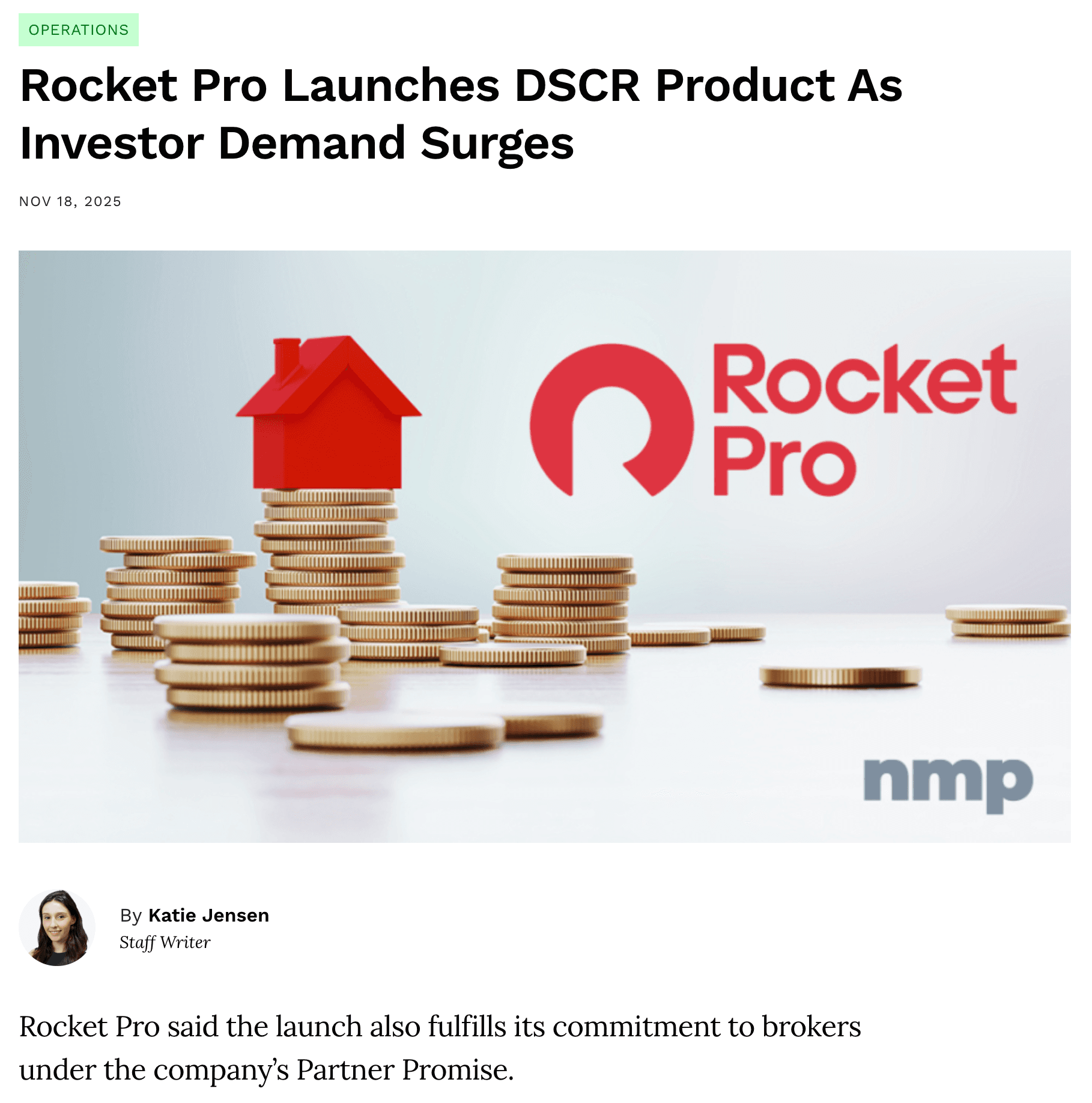
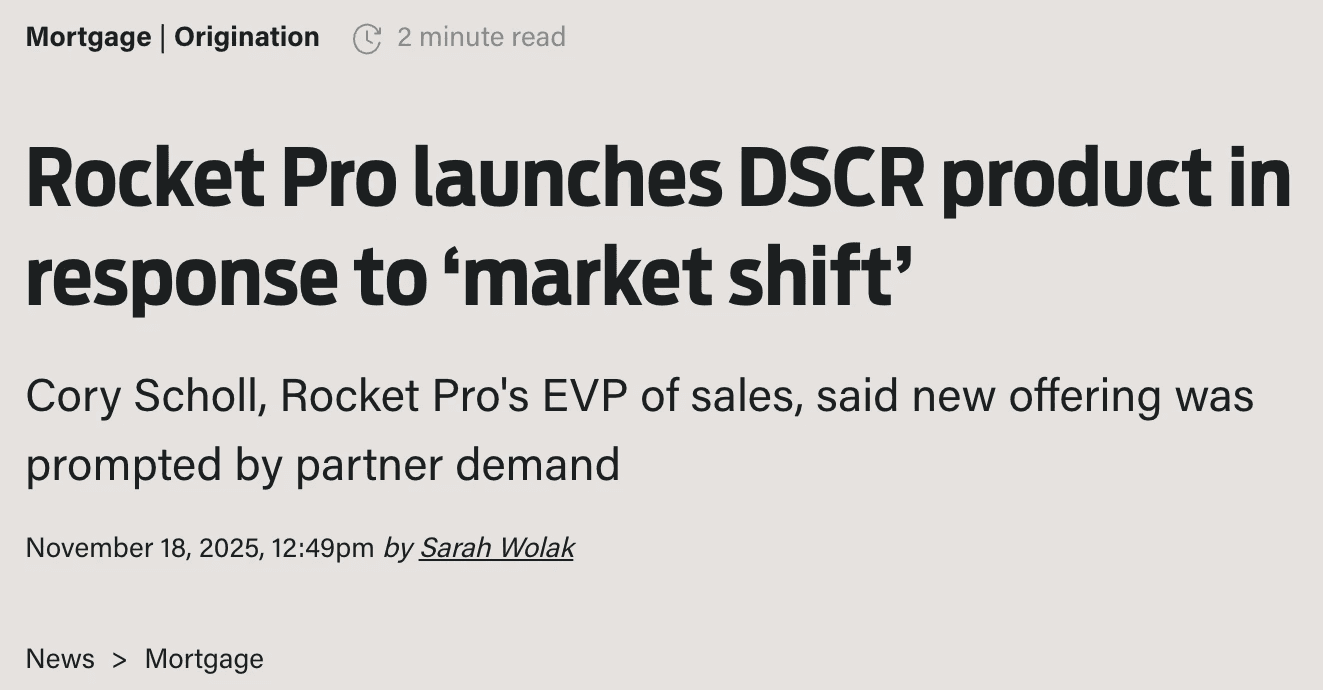
The launch generated industry attention across major mortgage publications, with coverage highlighting strong partner demand and market timing.
National Mortgage Professional and HousingWire both covered the November 2025 launch, noting DSCR loans had become one of the fastest-growing mortgage segments with over 4,200 transactions totaling $2 billion in January 2025 alone.
Coverage emphasized that the product fulfilled years of partner requests while aligning with Rocket Pro's commitment to pricing consistency, speed, and certainty. One broker partner reported a 65% month-over-month production increase after adopting the new DSCR product alongside Rocket Pro's AI platform.